

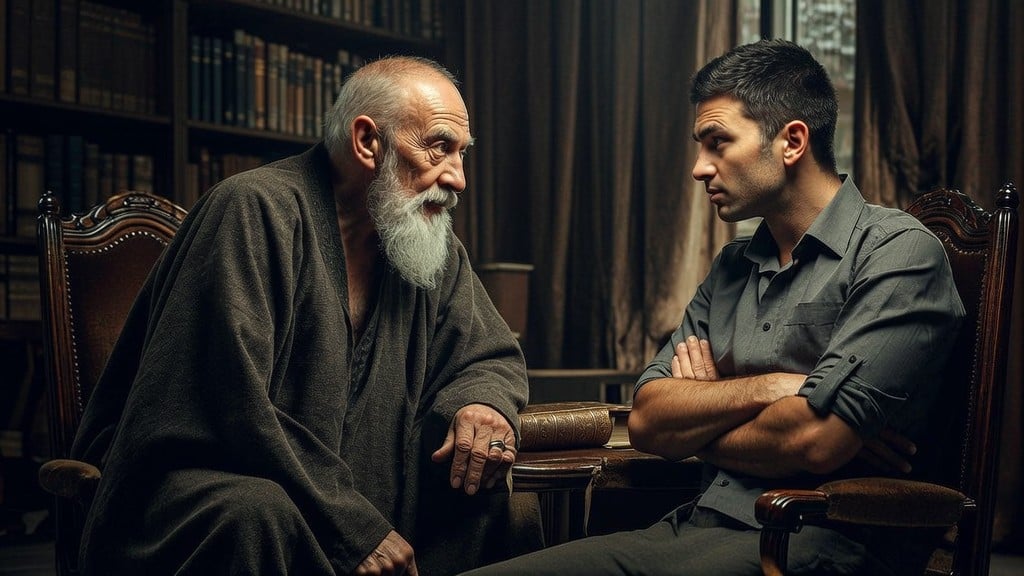
Act your age.
It’s a command we usually aim at brats who want to stay brats rather than growing up and owning up to their responsibility as reasonable citizens.
But the command to act your age can also be aimed at the people who grew up way too fast and own up to far more than their fair share of responsibility, people who have an outsized commitment to rules and shoulds. There are a lot of people running around, well, shuffling around, who act like they’re much older than they really are. And that’s a waste of years.
You may naturally be a young soul or an old soul, but circumstances may lead you to lean into that part of you so much that it hurts.
The reason I’m bringing this to your attention is that a lot of you who read this blog fall into the acting-as-if-you’re-older category. You’re acting not just like an old soul but like an old man and everything is about what you should do. Even if you’re a young woman. And, a lot of those who read this blog miss out on the possibilities of a more youthful approach to life, even if you are actually advanced in years.
But it’s not too late to get a little of that back.
Contents
Old Souls
Here are just a few indications you’re an old soul:
• You were very mature for your age as a child rather than wild, adventurous or carefree.
• You’re far more disciplined and controlled than spontaneous and creative.
• You’re more practical, risk averse, and serious than your peers.
• Reflection is natural for you.
• You like to share what you’ve learned from what you’ve been through.
• You think more in terms of what you should do than what you want to do.
• You’ve probably been through more struggles than most people.
This can be natural and authentic. But too often these traits turn rigid and destructive.
Understanding your personality through this lens can be helpful in achieving wholeness and balance, though it may be uncomfortable at first.
Archetypes and Why You Need to Understand Them
Whether you are acting your age depends a lot on how you’ve integrated two particular archetypes.
Archetypes are like apps or software programs. We can plug into them when we need to achieve goals. No woman would be able to raise a child without the archetype of the Mother. No fireman could do his job without the archetype of the Hero. Like certain software programs, archetypes can affect our entire approach to life, or at least a wide swath of it. They can be very helpful or they can be like malware that freezes up your psychic computer.
We don’t always make conscious choices about whether or not we plug in to software programs or archetypes. Sometimes archetypes come installed on your computer and you’re stuck with them until you deliberately remove them.
Or learn how to use them.
Archetypes are universal patterns of experience and behavior that evolved over time because they gave us some adaptive advantage. But as modern folk we can be energized or paralyzed by old versions of archetypes. They can function as grooves or ruts.
I find it helpful to know whether I’m in a groove or a rut. If I’m mindful of my finances, I’m solvent, and I can afford a new iPad, I’m in a groove. If I check my checking accounts three times a day I’m in a rut. If I’m able to bring awareness to the archetypal app I’m using, it’s more likely I’ll be in a groove than a rut.
A good software engineer can look beneath the surface to see if a program or an app is running on our computer without our awareness. A well-adapted human learns to do the same for their own psychology.
So today we’ll explore the archetype that, not well-managed, can drive us to be prematurely old; the Senex (pronounced SEN-ex), which is Latin for “old man.” We’ll also get to know his counterpart and sometime archenemy, the Puer (pronounced poo-AIR), which is Latin for, “young man.”
I’m sure you’ll recognize them once I point them out. The question is, are they behind the wheel, or are you?
Senex and Puer: Archetypes of the Old Soul and the Young Soul
Typically we have more of one of these programs than the other. We can all benefit from cultivating both and helping them to get along. While I am enlarging their differences to show texture, we usually express them on a spectrum, and ideally they work together. While these terms unfortunately drag along millennia of sexism, they can apply to females as well.
The chart below illustrates and compares how the two operate. Try to notice which side of the chart you are more aligned with.
Two caveats to head off some confusion at the pass….Many compulsives have a conflict between conformity and autonomy, and can feel both. The push for autonomy is often a reaction to their conformity. You can read more about that in this post about Demand Resistance, or listen to The Healthy Compulsive Project Podcast Episode 43.
And you may have some traits of both. That’s not bad.
| Puer | Senex |
| Spontaneous, immediate and present | Planned and careful about future, reflects, contemplates, cautious |
| Rebellious: questions authority and challenges tradition;
Won’t |
Conservative: upholds tradition and respects authority (not necessarily conservative in political sense)
Should |
| Expands | Contracts: sets tight boundaries and limits |
| Free | Disciplined and rule bound, follows shoulds |
| Creates and appreciates chaos | Seeks order |
| Wanders | Committed, Grounded and Goal directed |
| Move forward: creates, renews and invents | Holds Steady: maintains continuity and memory |
| Idealistic | Practical |
| Uses imagination | Bound to reality |
| Takes chances | Risk averse |
| Excitable, uses humor and plays | Serious |
| Says Yes | Says No |
As you probably noticed, they both have important roles to play.
The Compulsive Senex: Wise Old Man or Grumpy Old Man
The Senex is one of a few archetypes that describe the obsessive-compulsive personality. It can be expressed in a positive or negative way. Many who are on the unhealthy end of the obsessive-compulsive personality spectrum might as well be old men.
We like to think of ourselves as wise, but it’s likely that we’re considered stodgy and rigid. The grumpy old man is too cynical to be taken seriously.
He can manifest in a shadow or negative form if:
• Our underlying motivations are overly self-centered.
• Its attributes are used in an attempt to prove ourselves.
• We are exclusively identified with it.
This negative manifestation of the Senex may be inflated if it takes its role in the world too seriously.
Still, the Senex represents an aspect of our personality that is essential to wholeness, balance, and authentic expression. In its healthy manifestation the Senex is like the Wise Old Man.
Here is a table comparing unhealthy expressions and healthy expressions of the archetype:
| Unhealthy Senex | Healthy Senex |
| Dominating, devouring, coercive, authoritarian, tyrannical | Mentors, initiates, guides |
| Rigid, closeminded | Embraces structure, discipline, and order, contemplates, reflects, detached in a healthy way |
| Cynical | Continuity with the past |
| Dogmatic, controlling | Stabilizes, perseverance, stamina, endurance |
| Moralistic | Responsibility and moral authority |
| Judgmental, critical and punishing | Wisdom and sound judgment |
| Overemphasizes limitations | Points out possible limitations |
Notice that in each of these comparisons the unhealthy version of the Senex uses these traits habitually, whereas the healthy version uses them selectively.
Examples of the Senex
For an example, think about Yoda, the Jedi master from Star Wars who lived to be 900 years old. His 900 years of experience taught him a thing or two and he was capable of extraordinary feats. His strength, wisdom and integrity won him the respect of the entire Jedi community. He encouraged other Jedi heroes to use their connection to The Force for good. Perhaps more importantly in being a Wise Old Man or Healthy Senex, Yoda was willing to look at his own dark side and let go of his previous attachments. He used his traits selectively rather than habitually.
If you’re more of a Harry Potter fan, think of Dumbledore as an example of a positive Senex figure.
Examples of the grumpy or unhealthy Senex include Ebeneezer Scrooge from A Christmas Carol, Professor Umbridge from Harry Potter, and Nurse Ratched from One Flew Over the Cuckoo’s Nest.
The Elderwood Family
For some examples of how the Senex and Puer can look like in our own time, we’ll follow the four siblings from the Elderwood family.
The family was poor, and the parents were too overwhelmed to look after their children.
Martha
The oldest of the children, Martha, had to take on responsibility quite early. This was probably what activated her Senex archetype so dramatically at such a young age. She was both mother and father to her siblings, since her mother and father were too distracted to do any parenting themselves. Martha wasn’t going to take any chances of her younger siblings getting hurt, off-track, or shamed by their stressed-out parents.
To survive, she latched onto the idea that older was better. Old traditions, old ideas about how to do things, and cynical about new ways of doing things. Rules grew on her like barnacles. Rules about how to think, feel and act.
She considered her crotchetiness to be next to godliness. She knew what was right and she had no reservations about instructing those who were not so well-informed. But otherwise she stayed above it all. Above the fun and fondling and foolishness. Far above the fools who weren’t serious enough about life.
She was still like this at 37. That is, she was already old at 37.
She had mercilessly tried to keep her siblings on track, or at least her idea of being on track, with mixed results. Of her siblings, her sister became a conformer, and her two brothers became rebels.
Her friends, to the extent that she still had them, called her Grandma. In college she was the one that always got them places on time, kept them out of trouble and was the designated driver. But those relationships frayed with time, and she no longer spent much time with them. As far as she was concerned, they all needed a good long time-out to think about what they were doing, what with all their faffing about and never getting serious.
She excelled in her job as a project manager, but was failing at life, at least if you consider being happy any indication of success. Her life was filled with meaning, but no pleasure. She felt good about what she had accomplished at work and with two of her siblings. But she felt no joy at all.
Life was one big rut of “should.”
Florence
Martha’s sister Florence was five years younger, and the closest to Martha in temperament.
While Florence was sometimes hurt by Martha’s chastisements, she appreciated how much she cared about them and helped them. She did not need to react to Martha’s tips, as Martha liked to call them. These were really ugly ultimatums.
Florence was also cautious and conservative by nature, but it never turned rigid in her. She took the practical route of becoming a nurse and often felt fulfilled by the work. She married young and had children as soon as she finished college. She easily fell into the role of mother.
One would not call Florence a Senex by any stretch of the imagination, but all of the characteristics of that archetype were well integrated. She absorbed any wisdom that came her way and lived by it. She had no need to challenge or question authority. Life wasn’t easy, but she felt she had found her place, her calling. She had learned from Martha both how to live and how not to live.
If we consider a spectrum between Puer and Senex, Florence was on the mid-Senex side, with little need to express the creativity of the Puer. She enlisted Senex traits for the things that mattered to her, without identifying with them.
The Puer and The Puella
The Puer is the archetype that expresses all that the Senex rejects, including freedom and creativity. The female version of this is the Puella. He or she feeds on spontaneity like a cup of strong coffee. And without it, you’ve got a grumpy, resentful and petulant child on your hands.
The ancients gave the Puer an additional qualifier in some cases: the Puer Aeternus, meaning, the eternal youth, those people who won’t grow up, discipline themselves, aren’t serious enough and are always wandering around rather than grounding themselves and building something. The Peter Pans of the world.
Within the archetype of the Puer and Puella we also have a wide spectrum from adaptive to maladaptive. They are not necessarily poorly adapted. They are often the creative ones, the ones who challenge outdated rules, and move the world forward. They also know how to have a good time.
Here is a chart comparing the maladapted and well-adapted versions:
| Unhealthy Puer or Puella | Healthy Puer or Puella |
| Habitually questions and dismisses authority | Judiciously challenging |
| Avoids responsibility | Takes responsibility for change |
| Destructive | Creative |
| Rebel without a cause | Use their energy for meaningful purposes |
| Averse to settling down | Flexible and mobile, but not habitually so |
| Impulsive | Spontaneous but not reckless |
Again, notice how the healthy Puer uses these traits selectively rather than habitually.
Now let’s get back to the Elderwood family and see how the boys are doing.
Peter
Peter is Martha’s brother. He’s 35 and plays drums in a rock band. Well, sometimes. Whenever they get together. Which isn’t often to be honest. But he knows that any day now he’ll make it big. Meanwhile, he gets by by getting shifts as a barista, though his problems with authority make it hard to stay at any one job very long.
He’s charming and has no problem attracting women. But it doesn’t seem to occur to him that a longer-term, committed relationship could be more satisfying. Why tie himself down before his time has come? Besides, he’s having lots of fun now.
Or so he told himself. He too was actually in a rut, but one of automaton-like rebellion. He identified with the Puer archetype without knowing it, and that’s a very limiting identity.
He had watched his parents struggle to make a middle-class life, and struggle to keep their marriage together. That was not for him. Nor was Martha’s cautious, conservative approach to life. In fact, with her sweeping control and limitless limits, she turned him off just as much as his parents’ neglect had.
Bill
On the other hand, Bill, 27 years old and the youngest of the siblings, dropped out of high school to work in video game design. And he designed a life game that worked for him. He, too, was a rebel, but he adapted well. He did not rebel automatically or dismiss any practical considerations as foolish. He led with creativity, but followed with reflection.
When he came out and told his family about his boyfriend, they were both surprised and not surprised. He was always out of bounds as far as most of them were concerned. Martha did not approve. Peter was disinterested. Only Florence supported him.
But Bill’s natural joy, his large network of friends, and satisfaction in the creativity of his work sustained him. He had discovered, as had Albert Einstein, that creativity is intelligence having fun. And like his sister Florence, he had found his sweet spot. And his calling. He knew what his creativity was for.
Finding the Meaning in the Old Soul and Senex
Jungian analyst James Hillman may have been the foremost contemporary expert on these characters. Hillman himself was a Puer who ended up going his own way, founding a very informal branch of depth psychology called Archetypal Psychology, an approach founded on connecting with and honoring the archetypes within us.
Hillman encouraged us to remember that the word “psychopathology” means the suffering of the soul. He emphasized that any psychic suffering is best understood not as a mental illness, but as a window onto what our soul wants to manifest. We find meaning when we find our calling through our character, and when we live out that meaning consciously. Even though, and especially if, it seems flawed.
Our character may include strong elements of Senex or Puer.
So, for instance, if my “psychopathology” is an obsessive-compulsive manifestation of the Senex, what does my soul want to manifest through that? Mentoring? Tradition? Safety? Fathering? It’s not a symptom to be removed, but a calling to be answered. And it sours if I try to use it to impress others.
Either our Puer or Senex side may serve an important purpose, a calling, to benefit the larger world, and it may have meaning to lean into either archetype in that context. But in our personal psychology, ideally both are cultivated. Ideally they work together.
If they are not both consciously developed, the neglected side falls into the hands of the shadow and is expressed thoughtlessly and recklessly. Imagine the destructive results of the escapades of a repressed priest. Or the harm done by uninformed rants of the heedless rebel.
Hillman advocated using imagination to cultivate both sides of the spectrum. He suggested that by using the process of active imagination we could better know ourselves and our calling. This process is known today as “parts work” and involves creative dialogue with them.
Achieving Balance
The Puer and Senex may be natural and authentic expressions of who we are and what we have to offer. Certainly there are Old Souls and Young Souls among us. Thank goodness for that. But living exclusively as either a Senex or a Puer does not work well. They need each other.
For example, consider Jim Stark, played by James Dean, the protagonist from Rebel Without a Cause. He had no Senex examples in his life for containment and guidance. He’s impulsive, rejects rules, and tries to prove himself with youthful bravado. But in the end he seeks redemption by taking responsibility.
On the other hand, Ebeneezer Scrooge from Charles Dickens’ Christmas Carol, had no youthful, Puer energy in his life. At least until the ghosts of past, present and future showed him where he was headed and what he was missing. Then he changed his ways.
Identifying exclusively with Puer or Senex could also serve as an avoidance of risk, or of responsibility. And, trying to use the traits of either one to prove ourselves to the world is a betrayal of that part of us.
Here are five broad suggestions to help you find a better balance between these parts of yourself:
- Cultivate awareness of both archetypes.
• Are either the Senex or the Puer a dominant force in your life for the worse?
• Senex
• Overly serious?
• Overly responsible?
• Overly controlling?
• Puer
• Impulsive?
• Habitually defiant?
• Trouble with authority?
2. Understand what function they have served for you–positive or negative.
• Have you had to identify with one or the other?
• Senex
• Facilitating responsibility?
• Make you feel safe?
• Helped you achieve goals?
• Puer
• Declaring independence?
• Protecting autonomy?
• Inspire creativity?
• Has it felt natural, or reactive to be this way?
3. Acknowledge their effects.
• Has either archetype helped you move toward that which is most important to you? Or has it caused suffering? Identify the specific ways it has affected you. For instance:
• Senex:
• Being rule-bound,
• Criticizing others,
• Missing out on sex, hugs and rock and roll?
• Puer:
• Shortchanged yourself with short-term thinking?
• Hurt others with impulsive behavior?
• Defied tradition or authority self-destructively?
4. Get to know your personal Senex and Puer.
• Name them, just for instance:
• Senex
• Geezer
• Guardian
• Yoda
• Puer
• Rebel
• Provocateur
• Peter (Pan)
• Dialogue with them using imagination.
• What do they want from you?
• What do you want from them?
5. Integrate your neglected side.
• Name 3 ways your neglected side could help you achieve your goals:
• Senex
• Form stable relationships
• Actualize your creative potential
• Be less impulsive
• Puer
• Be more relaxed
• Have more fun
• Get along with others
• As you use your neglected side, try to remain aware of any uncomfortable feelings it brings up. Learn to be with these feelings rather than avoid them.
It’s time to act your age. It might actually be fun.
* * *
If you’d like to delve into the evolutionary underpinnings of these archetypes read the post A Conversation With Psychologist Steven Hertler: The Evolutionary Origins of the Obsessive Personality, which describes the benefits of fast (Puer) and slow (Senex) life strategies.
Discover more from The Healthy Compulsive Project: Help for OCPD, Workaholics, Obsessives, & Type A Personality
Subscribe to get the latest posts sent to your email.


Leave a Reply
Your email is safe with us.