

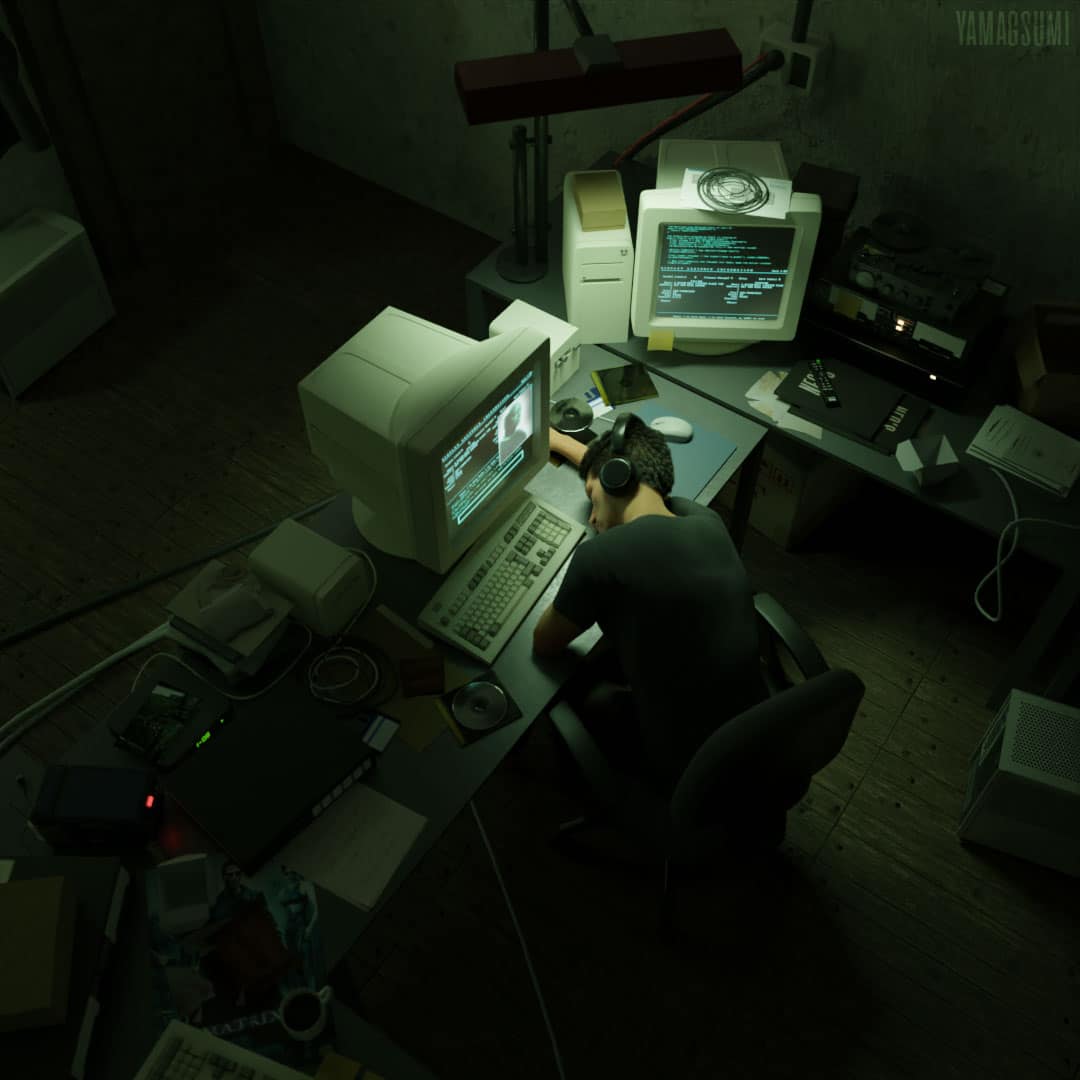
Wake up sleepy head.
You may think you’re living a life, but you’re just dreaming. Without waking up, you’re actually serving as an Eveready battery for a machine, giving your energy over to something else without knowing it.
This may sound familiar to some of you. It may also feel familiar to you, since it’s probably happening inside you. This is the story behind the classic film, The Matrix, and you may remember it for a reason. It tells us something important that, while hard to swallow, is also enlightening.
I’m going to suggest a way of understanding this film that may change how you see yourself and your world. For the better, I hope.
The metaphor of being taken over in The Matrix is particularly apt for those with obsessive-compulsive personality, which has been compared to a “living machine” because it can become very mechanical. There’s good reason why there are so many stories of machines taking over. And it’s not just about AI and computers. They describe what can, and often does, happen inside of us.
The machine that’s draining your energy is inside of you, not outside.
In order to bring more understanding, compassion, flexibility and hope to this condition, I’ll be shining a light on the inner workings of the machine that can make us unhealthily compulsive. This way you can choose whether to take the blue pill or the red pill, and whether you want to wake up to the reality you’re in.
Contents
The Matrix: An Alarm for Us All
The Matrix is one of my favorite films because it shows what we’re all up against as a society, how we can be controlled without our knowing it. Recent research on the subject of psychological priming reveals just how vulnerable we are to influence, even as seemingly innocent as a single word or image. If you thought you were exempt from influence, think again.
In one study, participants were asked to complete a scrambled-sentence task which had words like Florida, gray, bingo, wrinkle, and retired — words that we usually associate with elderly people. After the task, participants walked down a hallway to leave the lab. Those who were exposed to “elderly” words walked more slowly, even though they weren’t told anything about elderly people, they didn’t consciously notice the theme, and they denied being influenced by the words.
That’s scary.
Getting back to the film, its basic premise is that humans have been programmed to think that they’re living life consciously, when they’re actually unconsciously embedded in a womblike pod so that computers can siphon off their energy to sustain themselves. The humans are, in effect, in a deep dream, oblivious to their state. They’re enslaved, unconsciously, in a computer simulation.
At the start of the film, the hero-protagonist, Neo, is asked to choose whether he will take the blue pill and remain comfortably numb, or take the red pill and become uncomfortably aware of the gravity and magnitude of the situation. He takes the red pill and wakes up. And it’s no joy ride. It’s an extremely difficult odyssey, which is why most people choose the blue pill.
Others who have also woken up live underground, and they know how to party. Many people with OCP have had their emotional needs go underground.
If we look at the film on the individual level, rather than societal, it shows how we may not be living the lives we think we’re living. We’ve been taken over by a psychological machine.
We created computers to make our lives easier, but, at least in The Matrix, they’ve taken over. In the same way, we’ve come up with strategies to try to make our lives easier, to deal with our emotional challenges and protect us from shame and fear. But those strategies took over, too. Like the computers in The Matrix, these strategies have come to rule our lives, so much so that we are no longer awake. We’re dreaming.
The Strange Comfort of the Obsessive-Compulsive Dream
Interestingly, we’re told that in the first iteration of the matrix the computers attempted to make the dreamlike state perfect so that everyone would be happy. But it was a disaster. Humans needed the suffering and rebelled. The computers had to come up with a new matrix in which there was misery so the humans would be satisfied and not resist. That could explain why people with OCP are reluctant to change. The suffering feels natural and necessary.
And, ironically, matrix means mother. There is a strange comfort in this dream of staying in the womb.
I often use the metaphor of being hijacked to describe how our defensive strategies usurp our autonomy, passions and energy. People who are unhealthily compulsive lose control of their skills and energy when they try to use them to feel more secure–rather than do what they feel passionate about. And they aren’t aware of it.
It may be too disturbing to wake up to how things have flipped and challenge their view of the world.
Imagine how this might be happening inside of you. You think you’re awake, but you’re really just following the orders of a psychological machine that convinces you you’re awake. This psychological machine is just doing what it thinks it’s supposed to do. But it has gone rogue, and things like control, perfectionism, overworking and planning have taken over.
It’s as if the machine has drugged you to sleepwalk and work a job you don’t want.
The protagonist’s task is waking up and taking back control from the machine.
Deceptions of the Compulsive Personality that Lead us to Seek Control
I debated whether to call these delusions or illusions, but neither term accurately describes the experience. Still, I’m going to use these terms. Loosely. While they aren’t clinically accurate, they may be the terms most likely to wake us up.
These dreams are not simple cognitive distortions either. They are more comprehensive than that. This why is the condition is ego-syntonic (not only acceptable but a source of pride) to those at the unhealthy end of the obsessive-compulsive spectrum. They can’t see the suffering they cause themselves and/or others. They feel it’s perfectly fine, desirable even, to be so controlling and rigid. Some clinicians don’t recognize their own OCPD.
We are deceived by strategies that may have been adaptive to some extent when we were younger but no longer are. And they have taken over. The effect is thorough and far-reaching. The deceptions we are subject to are many, and work together to block us from seeing our world accurately. The symptoms of OCPD together weave a web, a maternal matrix, that leave us feeling it’s safer to stay than to question.
We’ve been duped. And we need to wake up.
While this experience is not what we usually call psychotic, we do lose touch with reality–to some extent. We experience these delusions deeply and viscerally, and we can’t just talk ourselves out of them.
Specifically, those of us with obsessive-compulsive personality traits may have delusions or illusions that say:
• We can and should be perfect. This will cure our insecurities and lead to comfort.
• The world can and should be perfect.
• Being harsh on ourselves will make us and the world better.
• We are deficient and need to prove our worth, goodness or competence.
• We are living a good, fulfilling life by exercising such control and being perfect.
• Everything is urgent.
• Self-discipline will eventually lead us to a time when everything is resolved and we live in a state of contentment.
Imagine Sandra, a middle-aged middle school teacher dreaming the obsessive-compulsive dream. When a student fails she blames both herself and the student. Perfection is possible in her book, and someone must be held responsible. Because part of her feels she’s responsible, she doubles her efforts to prove she’s competent. This results in pressure on herself and on her students. She rails when the principal lays out new procedures that take up her time, and when her husband brings the car home with no gas in it. So many mistakes in the world and so little time to fix them! Still, this seems like the right way to live. She keeps telling herself that things will ease up and she will be able to enjoy life later if she keeps her nose to the grindstone. There is a strange comfort in the web of her strategies.
This is what happens when you’re living the obsessive-compulsive dream that the machine has implanted in your head.
But if you wake up and recognize these as delusions, as if recognizing that you’ve been blinded for years, it can help you to live differently.
Carl Jung and The Battle Against Complexes
Twentieth century Swiss psychiatrist Carl Jung was onto this. After years of scientific research with the Word Association Test, Jung called the machine that takes us over a complex, a part of our personality that operates autonomously and mechanically. It’s worse than habit. Habits are like simple, fast growing weeds that you can easily pluck. Complexes have massive root systems that we can’t simply pull, once and done.
You might think you can control this mechanical complex, but it controls you. Jung said that we may think we have a complex, but the complex really has us. Or, as I ask in my book, The Healthy Compulsive, are we driving, or are we being driven?
Typically, we’re asleep at the wheel, unaware that someone else, or something else, is driving.
• If you have a superiority complex it might be difficult to stop telling others what to do, acting as if you know more than others, because the complex is in control.
• If you have a perfection complex, you might believe that everything and everyone needs to be perfect, and if you fail to achieve it you need to chastise yourself.
• You might have a negative father complex in which you resist anyone who exerts any authority, and you believe that’s the right thing to do.
• You might have a dependent mother complex in which you expect to be taken care of.
It’s important to note that complexes are not all bad. In fact, once understood and integrated, they can be adaptive. Once you wake up to the complex, you can start to take back the wheel.
• You might have a positive father complex that helps you to deal with authority, and use it to raise your children or teach your students.
• You may have a positive mother complex in which you can accept and give nurturing in a fulfilling way.
Similarly, the part of you that craves completion, productivity, goodness, and psychological mastery can be positive and adaptive as well–if you wake up from the dream.
Loss of the True Self
Perhaps worse than what we do do when under the control of the machine, is what we don’t do: live authentically and express our true selves. When we get caught up in obsessing, procrastinating, overworking, unfairly criticizing or cleaning we are not living authentically. But this is hard to see because complexes are very savvy and they hijack what’s authentic about you so that you think you’re being authentic when you’re really under their control.

Strangler Fig Tree taking over its host
Putting this in more practical, psychological terms, the strategy we developed to deal with challenges when we were younger slowly grows and takes over. We enlisted our skills and talents to ensure our status. You might tell yourself you’re working 70 hours a week to support your family, but your true motivation is to compensate for guilt or feelings of inadequacy, and you’d really rather to be out singing at open mics.
For a more graphic metaphor, our strategies and complexes can operate like strangler figs, the trees that grow on the surface of another tree and eventually kills their hosts.
The Bigger Picture
Jung wrote: “Much of the evil in this world is due to the fact that man is, in general, hopelessly unconscious.”
Whether or not the situation is actually hopeless I can’t say, nor can anyone else. But we can all choose to do what we can to bring consciousness to the world.
It’s never been my job as a therapist to make my patients “better people,” but to help them become aware so that they can make better decisions about how to live.
And I do believe that this can make the world a better place, especially with the people that have obsessive-compulsive traits. Their determination makes a big difference in the world, and that can be for better or worse. Most of the movers and shakers of the world are obsessive, compulsive, resolute and adamant. It’s hard to stop them because they are obsessive and compulsive. They’ve done a lot of good–and a lot of bad.
When we wake up from the illusion that we’re deficient and need to prove ourselves, we behave better.
Waking Up
I like to think that I’m awake now. At least partially. It’s not like this was a sudden awakening or that I’m completely aware all the time. It happened gradually, awakening as I learned more about the compulsive personality generally, and mine specifically. I continue to wake up as I bring more consciousness to the computer-like complexes that had partially hijacked my authentic self.
I can recognize the obsessive-compulsive dream by:
• Its sense of necessity (things have to be a certain way).
• Urgency (they have to be that way now),
• Physical tension (as if the center of my being rises up out of my gut, migrates to my shoulders, preparing for conflict, and makes me lean forward).
I’m more likely to spot when I’m about to criticize myself or others out of habit rather than helpful assessment, when I take things too seriously, or when I get tense and overwork. Perhaps most importantly, I’m more likely to spot when I’m not being true to myself.
I try to remember the feeling when I do wake up from the dream.
We need to acknowledge that some people are in dangerous positions and do need to be alert. But even then, the dream is not helpful.
The fact that there were three Matrix films tells us that waking up is not a one-time thing. Neo had to keep fighting off the many incarnations of the computers’ henchman, Agent Smith. Similarly, we need to continually question the illusions that persist despite relative awareness.
Be courageous and question whether you are operating under the illusory dream that:
• Rigidity and righteousness serve you well.
• You can be perfect and should shame yourself when you are not.
• Living perfectly will eventually lead to fulfillment.
For us to take the red pill and wake up means sitting still and feeling our distress rather than defending against it by overcontrolling, overworking, and overthinking. We need to take the risk of not using the defensive strategies we have used for decades. We need to unplug from the matrix. Then we might see what we have wanted to ignore for so long, the illusion of our insecurities, the many things that are out of our control, and what we’ve lost by doing so.
I’ll close this post just as The Matrix film closes, with Neo’s message to the Matrix machine. We would all do well to adopt it.
“I know you’re out there. I can feel you now. I know that you’re afraid. Afraid of us. Afraid of change. I don’t know the future. I didn’t come to tell you how this is going to end. I came to tell you how it’s going to begin….I’m going to show them what you don’t want them to see. I’m going to show them a world without you, a world without rules or controls, without borders or boundaries, a world where anything is possible. Where we go from there is a choice I leave to you.”
* * *
For a thorough guide to waking up from the strange comfort of the obsessive-compulsive dream, read my book: The Healthy Compulsive: Healing Obsessive Compulsive Personality Disorder and Taking the Wheel of the Driven Personality.
Discover more from The Healthy Compulsive Project: Help for OCPD, Workaholics, Obsessives, & Type A Personality
Subscribe to get the latest posts sent to your email.


1 Comment
Leave your reply.