

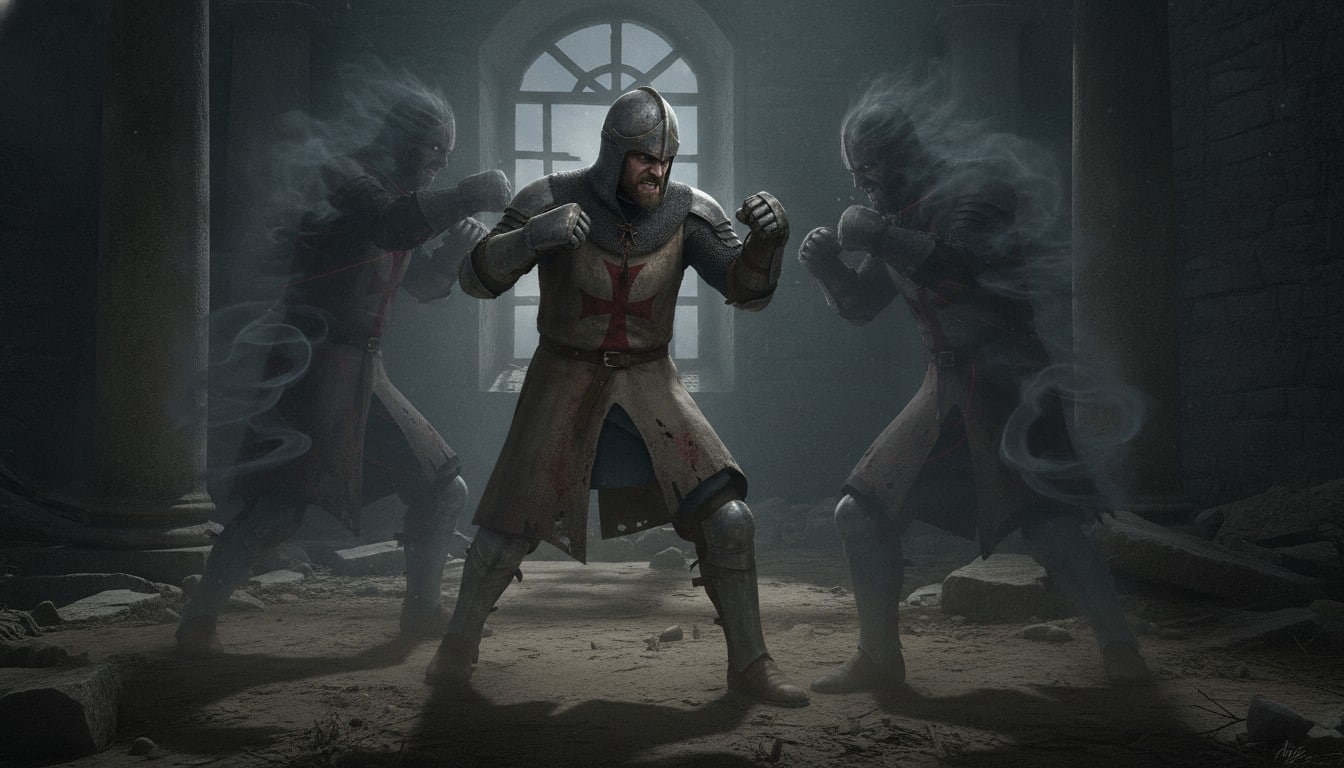
Are you exhausted by internal battles over injustices you can’t control? You may be fighting ‘Holy Wars’ without knowing it, rather than letting go of resentment and redirecting that intense energy toward what actually matters.
Something was bothering me recently that I didn’t want to let go of. It seemed like it just wouldn’t be right to move on and forget about it. “Just wouldn’t be right” in this circumstance wasn’t about right angles or symmetry or completing the Sunday crossword puzzle with that one word that was stumping me.
I felt that someone had done something that just wasn’t right. As is often the case with people with obsessive-compulsive personality, I felt I needed to stand up for the principle of the thing. It was part of the epic battle between order and chaos.
But the problem that was really causing me trouble was my insistence on justice when it was out of my control. It was one battle in my ongoing Holy War against injustice. Each of us who has obsessive-compulsive personality tendencies has our own Holy Wars, the issues we’ll die on the hill for. In this case the primary one for me was fairness.
These Holy Wars are not always obvious. It’s like a secret police agency set up to spot and stop rulebreakers. These guys are on a crusade, but they’re not wearing uniforms.
I offer this post as help for those of you whose minds are cluttered with the numerous shoulds of a righteous life, shoulds not just for yourself, but for the rest of the world as well, as help toward letting go of ineffective communal resentment. And, just a hint of where we’re going with this, the real battle is against that constant wave of negativity inside you—not the sloppiness, laziness and deceit inevitably found in the world out there.
Let’s get to know the old battle and the new battle.
Contents
The Old Battle: Challenging Wrongs in the World in Your Head
The old battle is one we’ve largely played out in our heads. It’s not like we always go out and stand up for what we believe. We just shadow box from the inside sidelines. Which means we can never win. You can’t vanquish an enemy from within your safety zone. So we die a very slow death without ever reaching the proverbial hill.
Here are just a few examples of the impractical things we fight for in our mind:
• People shouldn’t park in handicapped spaces without a handicap tag.
• People shouldn’t park themselves in doorways when others are trying to get by.
• Companies should not deceive or manipulate customers through sales pitches.
• Customer Service should not keep us on hold for 32 minutes.
• Technology should always work exactly as it is supposed to.
These are all good causes, and if you’re willing and able, take up arms and legs and stand up for your cause. But if you’re not willing and able, choose your battles. Are you willing to die psychologically on these hills?
Most of us would say that we’re not willing to. But we still do.
I call it a Holy War because even if you’re not spiritual or religious your cause may take on profound meaning for you. Not subscribing to a religion or spiritual practice may leave a vacuum in your life that can be filled either consciously or unconsciously by holy wars.
Holy is related to whole, and you may have your own crusade about how to make the world whole again. Your crusade may even be against all crusades, but that’s a crusade as well. It probably feels like something that’s not only fervently important to you, but also something you have a responsibility to stand up for.
I’m down for that. I’m up for it too. But whichever direction you choose, it’s a total waste to fight it just in your head.
The New Battle: Letting Go of Resentment and Standing up for Meaning
In the new battle we redirect the energy we previously put into unrealistic crusades toward realistic and meaningful crusades. The goal is to substitute productive causes for inevitable folly.
Winning the new battle requires us to see that it’s not a particular “should” or circumstance we’re up against, but the persistent habit of thinking that we can’t rest until justice is served. Before we can choose between realistic and unrealistic battles, we need to admit that crusades are something we take on habitually and for reasons neither obvious nor wise. It’s characterological, not circumstantial, and it’s characterized by promiscuous negativity.
But chucking the old attitude may leave a vacuum, and that’s a good thing, because there should have been something else better there all along. In fact, the old resentments and holy wars may just have been substitutes for the realistic battles that match our values. Those aren’t always so easy to wage.
Gary Wrestles with the Corporate Scofflaws
Problem is, sometimes it seems like we’re actually fighting the Holy War, but we’re really just shadow boxing. The external battle we’ve taken up may be futile. Here’s my own recent tale of woe.
I fought the battle and the battle won.
The bank I recently bought a car loan from made a series of blunders which ended up in them believing I owed them $24.82. I’ll spare you the details, but suffice it say that their mis-construances were stupid on stilts. I kept arguing with them over the phone, sending multiple copies of the documents they wanted, and trying, but failing, not to get furious about it.
It just wasn’t right and I was going to fight my Holy War against their incompetence, intransigence, and inanity. But mostly against their unjust activity. It was the principle of the thing.
I lost.
They kept calling, emailing and texting for their precious $24.82. Apparently, this is their way of love-bombing new clients. I finally gave up, conceded defeat and forked over $24.82.
The Holy War I was fighting inside of me went like this: “I can’t give up, it just wouldn’t be right to let them off the hook. It’s my responsibility to the world to fight.” My crusade ended up costing me far more time and psychological angst than the loss of $24.82, but I felt compelled to stand up for what was right. And that was wrong. My crusade didn’t amount to a hill of beans in the grand scheme of things.
The real fight was within myself.
Why Do We Feel the Need to Hold On? Left-Over Programming
Let’s trace the tracks of my fears. None of this was rational or conscious, but its presence was palpable. I felt that if I let the bank get away with it, they would know that they could take advantage of me and everyone else they loaned money to. Then the world would fall on its tuchus. Civilization would crash.
This is a very old, left-over feeling, one many of us with OCP feel. There’s been reason for how we’ve handled our sense of righteousness and responsibility in the past. Our ancestors lived in tribes of 82 people and if anyone took advantage of the group, they were immediately taught a lesson, lest they imagine that was going to be standard operating procedure going forward. They’ve passed that lesson down to us in the form of righteous indignation and punishment.
But that doesn’t carry water any more.
My personal vendetta might have gotten me back my $24.82 in a tribe of 82, but not in one of 300 million.
It’s a weird thing. A very weird thing. But somehow we feel that if we let go of the issue, we’re not doing our part in this Holy War. It’s almost as if it were a sort of prayer. As long as you’re praying or complaining mentally, it’s OK. You’re doing your part.
It feels as if resentment toward the rulebreakers has a purpose.
We used to feel that we were all foot-soldiers in the battle against evil, whether we were on the front lines or not. As if we were all creating thought waves that could push the enemy back.
Carl Jung would say that this motivation for Holy War comes from the collective unconscious, a shared level of our psychic makeup, motivated by archetypal energies.
But it’s not just genes, evolution, and the collective unconscious that motivates us to fight these crusades. There may also be more recent programming that sets us off, motivations that come from our personal experience and personal unconscious.
Other Causes for Our Holy Wars: Personal Experience
For instance, in my case, were there other feelings, feelings from my personal unconscious, that motivated me to fight the crusade against a bank like a worm against a wooly mammoth? Obsessiveness is primarily an effort to think our way out of a feeling. Was I trying to avoid disturbing feelings left over from my personal experience?
Here are some other feelings that could have been at play:
Guilt.
Soldiers were promised that their sins would immediately be forgiven if they went on a crusade. Military service became a sort of penance to compensate for those times we’d rather not mention. I don’t have much of that sort of guilt stored up, but I do have to admit there were times I wondered if I actually had sent them every document they wanted. Maybe I had failed to be perfect as they accused me. Not wanting to feel this, I may have unconsciously adopted the old strategy: the best defense is a good offense. Attack them before they can attack you.
Anger and Personal Resentment.
If you’ve been hurt by injustice, it’s understandable that you’d take up psychological arms against it to achieve revenge. As the youngest of three children, I was often the one blamed for what went wrong. Or at least that’s how I remember it. My siblings might tell you otherwise. Don’t believe them.
Anyway, I don’t like being falsely accused, especially being accused of not being meticulous. That’s part of my identity, after all.
Fear.
Rationally I knew the loss of $24.82 was not going to put me out on the street, under a bridge and deep into dumpster diving. But I do have a habit of frugality finely honed during decades of post-secondary education. After all those years of loans and penny pinching, I prefer solvency.
While it’s possible any of these three motivations were also at play, the one that felt strongest to me in this case was the collective layer, the feeling that we’re all supposed to fight injustice whenever we see it. I should be contributing my voice to the roar of communal resentment. It’s an important motivation for many of us, but one that often gets stuck in the “on” position far too long.
Letting Go of Resentment and Changing Direction
Here are 4 steps to help you stop taking too much responsibility for futile battles. Our Holy Wars are often our default, and it takes conscious intention to let go of the ones we choose not to fight.
- Name your crusades and choose your battles.
Which ones are both truly important and manageable? And which ones are just based on old programming, guilt, fear or anger? Where do these battles stand in your list of 5 or 10 most important issues? In my case, my peace of mind stands much higher than $24.82.
Label the campaigns you get stuck in so you can pivot away from them quickly in the heat of battle. This is why soldiers wear uniforms. It’s not to support the garment industry, it’s so you can tell the good guys from the bad guys.
When you recognize you’re caught in an old battle, you can say, “Oh, that’s not me. That’s a leftover crusade. I don’t have to listen to it.”
- Smile at your Holy War.
Breaking the force of the idea may require you to enlist your body. Smile at the Holy War. Yes, I mean that physically. While the effects are not colossal, there is data to support the idea that smiling can help to change your mood. Your nervous system reacts to what the body does. When you smile it can activate the parasympathetic nervous system, which functions like the brakes of your psychological car.
Allow the corners of your mouth and the edges of your eyes to break into a beam, grin or even a sneer. Then exhale like you really mean it, like you’re really letting go. These two physical actions can interrupt the pull of a negative thought.
- Tell the habitual Holy War goodbye.
Imagine you had signed a document committing to this Holy War. Rip it up like a draft card, throw it in the river and watch it float downstream. We will all be just fine without that crusade. Remember that learning to let go is more important than any particular Holy War you’ve been fighting.
- Actively turn your attention to something higher on your list of values, something you can stand up for in real life. I have crusades that are more meaningful to me than setting banks straight. These are issues I can put my energy into, like helping people not get caught up in obsessive-compulsive campaigns and not taking responsibility for things that are out of their control.
That’s a crusade I can fight for.
* * *
If this post [episode] was helpful to you, check out The Ten Commandments of The Obsessive-Compulsive Personality.
For those of you heading out for some summer R&R, check out my previous post, How to Survive Your Vacation. Our responsibility complexes don’t take time off when we do. It’s a good time to practice dismissing them.
Discover more from The Healthy Compulsive Project: Help for OCPD, Workaholics, Obsessives, & Type A Personality
Subscribe to get the latest posts sent to your email.


3 Comments
Leave your reply.