

Do you believe that your willpower is unlimited?
Maybe I should have asked, does part of you believe it. If so, you might want to have a heart to heart with that part.
According to ego-depletion research, when you exert too much self-control, you eventually run out of energy. Sorry to break the news, but you do not have endless energy. Call it burnout. Call it overtraining syndrome. Call it hitting a wall. It’s reality.
But this probably isn’t news to other parts of you, the other parts that suffer the consequences of running on empty far too often.
To me the interesting thing is how and why we keep acting as if willpower is unlimited, trying to override what we know and feel by leaning into it as if our body had discovered how to use nuclear fusion for boundless energy. We keep overdrawing our physical and emotional checking accounts–despite the exorbitant bank fees we get hit with.
By willpower I mean the determination to override fatigue, fears and fancies to achieve a certain result. Willpower run amok tells you that it can master all the other parts of you, and that it is the better part of you, better than the part that has other ideas about what to do with a Saturday afternoon, like lying in a hammock and listening to Norah Jones.
Contents
The Broken Gauge and the Empty Tank
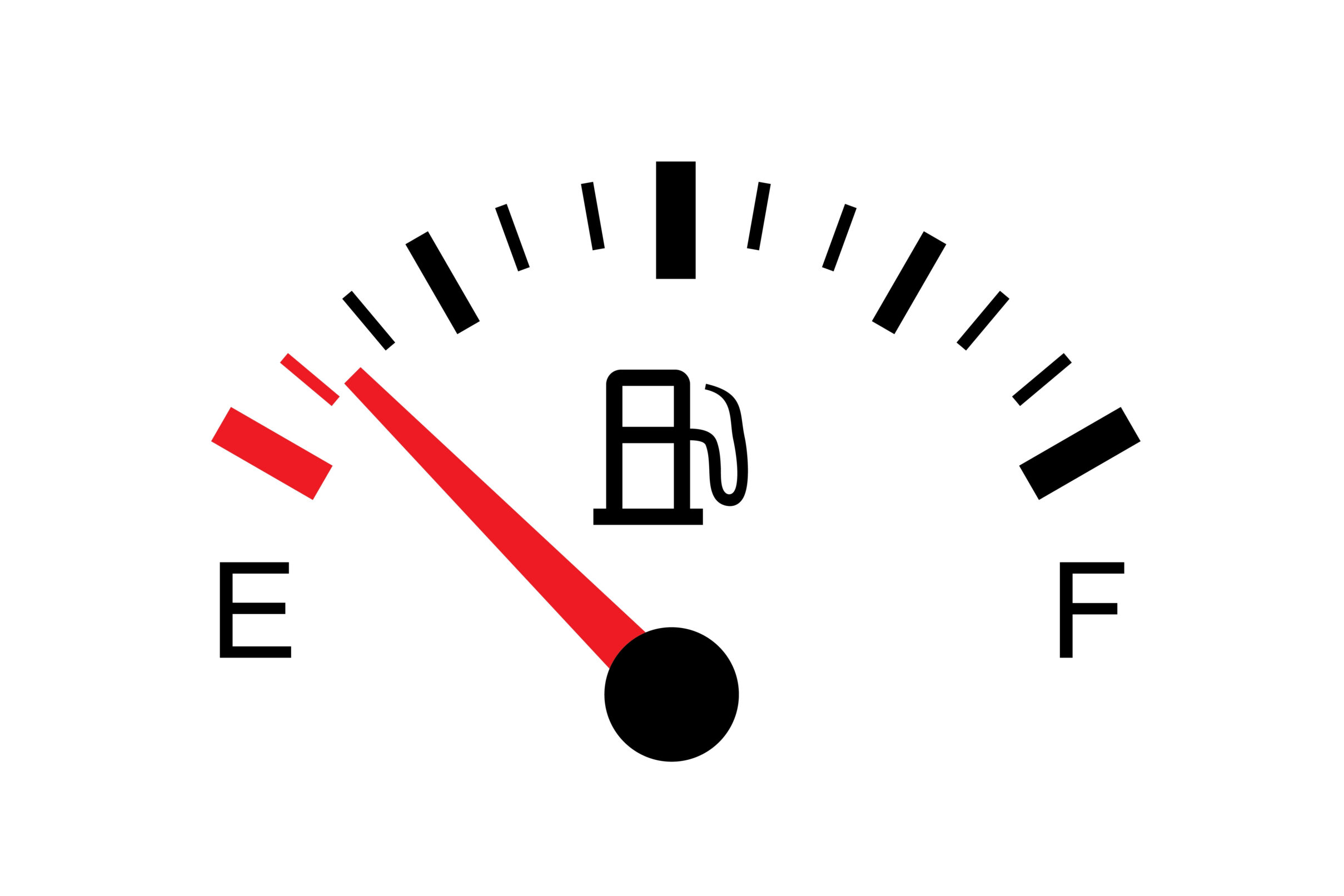
Our analogy for today is simple. You have a gas tank inside of you. Your fuel gauge is broken so you don’t know what’s there. Willpower takes over and tells you “Keep driving. I’ve got this.”
You keep thinking, “Man, this car gets amazing mileage! I can make it to Timbuktu!” But instead you keep running out of gas in the most inconvenient places, and you have to keep using willpower to walk to get more gas.
Wince and repeat. For a while. Eventually you ruin your engine by running on empty too often, and everything is a non-starter.
Just in case my analogy isn’t clear. The tank contains your energy, fueled by a sense of who you are and what you value, your identity and motivation. When your gauge is broken, you’re out of touch with these. You don’t know what you feel, physically or emotionally. Willpower is your determination and drive—healthy or unhealthy. When you run out of gas, you make up a story about what’s happening, and you rationalize carrying on as usual. The results can be painful.
The broken gas gauge is akin to alexithymia, the inability to give voice to our feelings—the unspeaking heart.
Why do we do this to ourselves and what can we do about it?
In order to answer this, I’ll explore the results, causes, and solutions for the overuse of willpower. First, I’ll review the research data about depletion theory. Then I’ll talk about why people keep draining themselves despite the consequences. Finally, I’ll offer some suggestions about how to get these facts past that stubborn brain of yours and into your gut so that you can actually change how you behave and feel.
Results: Frequent Depletion Leads to Long-Term Deterioration.
Willpower is a great tool to help us reach our goals, but without contact with body, values and emotion, it can take over and become a destructive boss. It likes to think of itself as unlimited and upright, but the research indicates it’s in fact finite and potentially toxic. Once we start running on empty we make mistakes, make our health worse, and make it less likely we’ll reach our goals. Over time it erodes our physical and mental systems.
This doesn’t mean that we’re weak. There are lots of people with incredible will-power and self-discipline who had to slow down because willpower pushed them too hard. They tried to go too far on a tank of gas without recovery.
Ask Simone Biles or Michael Phelps. Ask Beyonce, who experienced confusion, exhaustion and a loss of grounding after pushing herself too hard. She had to take a year off from performing.
When I was younger I experimented with shorter sleep schedules because there was so much I wanted to do. I swore I’d wouldn’t spend a third of my life sleeping. I’d sleep about 4 hours, go running, study and practice the trumpet. I’d nap midday. Willpower buoyed me for a while, but it wasn’t sustainable. The result was that I’d fall asleep in orchestra rehearsals. And that’s not A Good Thing. But my fuel gauge was working well enough that I could see what willpower was doing to me.
The Overuse of Willpower Leads to Self-Reinforcing Loops
The overuse of willpower can cause loops of self-reinforcing behavior. Cause becomes effect and effect becomes cause, each one intensifying your symptoms. Pushing too hard leads to chronic stress and insufficient recovery. This leads to fatigue, mood disruption, and performance collapse. Which we try to compensate for with more willpower.
It’s bad enough having low energy, but then we make the situation worse with accusations of malingering: “There’s nothing wrong with you, you’re just weak and lazy.” Next thing you know you’re driving your partner, parents or colleagues to up their Prozac—or increase the frequency of their own therapy because you’re getting too difficult to be around.
☠️ Returning to our fuel tank analogy, repeatedly draining the tank of willpower because your gas gauge is broken damages the system it’s supposed to empower. You can use willpower to push through occasionally, but do it too often and then it’s not just that the tank is empty, the whole system has deteriorated.
Example: A Well-Intentioned Teacher Burns Out Her Fuel and her Strength
Melissa worked at a middle school in a poor neighborhood. Resources were scarce. When funding cuts made things worse, she pushed herself to work harder. She committed to lighting a candle rather than cursing the darkness. She used willpower to get herself to work in the morning.
Her motivation to help was genuine, but there was also pride. Strength was her identity, and damn if she was going to let politicians, bureaucrats and school principals take that away from her.
She eventually had to take medical leave because she was clinically depressed. She tried to return to work, but eventually had to resign.
She ended up finding a position at another school with a lower salary but better life balance. It took her years to recover from the sense of futility she had tried to push past at her old school. It’s true that other teachers were able to endure it, but they knew how to pace themselves. They understood that much was beyond their control and tried to focus on what was within their control.
The Research: Self-Control Can Deplete Us
Ego‑depletion research shows us that Willpower can drain us when we push too far and too often. Willpower cannot make up for that depletion—even though it tries to convince us it can. After effortful self‑control, people are less able to resist temptation and regulate behavior. It’s not that Willpower is bad — it’s that excessive or rigid self-control can become costly, both in the moment (fatigue) and over time (reduced emotional and relational wellbeing).
Once you’ve exercised excessive self-control for too long, you might far it harder to resist naps, irritated reactions, binge watching television, or having sex with that certain someone whom we won’t mention.
Trying to push through without sleep diminishes performance, disrupts hormonal activity and makes it harder to recover. Willpower can temporarily override the limits of the body—but the body eventually pushes back by going on strike.
This might make you wonder, just for instance, “Is this why places where sexual abstinence is the suggested solution to raging hormones actually have higher rates of unplanned pregnancy?”
It’s not that willpower exactly causes it, but it doesn’t lead to the prescribed purity either. Self-control is not a viable solution to resist The Evil One in the heat of battle.
Instead, it can drive you crazy.
Speaking of crazy, too much self-control is associated with psychiatric disorders, including depression, anxiety, perfectionism, inflexibility, emotional expression and problems in relationships. (Hey, sound familiar to anyone? I mean like, OCPD, obsessive-compulsive personality disorder maybe?)
Is this always the case? Does everyone who exercises willpower always burn out? No. Some people use it wisely. It’s how they push through that makes the difference. Motivation and identity can both affect the results of strong self-discipline. These factors turn out to be very important in recovery, as we’ll see when we explore solutions.
Causes
We could find many reasons that we can’t stop overusing willpower, but let’s narrow it down to two overlapping causes: limited identity and skewed motivation.
Narrow Sense of Identity
Strength becomes an important identity to us for a reason. Without it, we would have felt too vulnerable to cope with the real dangers around us. By identifying I mean you think of that as who you are and behave accordingly. It is usually a very limiting identity.
Those who are the Doer/Worker type of obsessive-compulsive personality often fall for the “If I just try harder I can do it” mantra. For them, productivity is a sign of their strength and they will sacrifice in order to get things done. Staying up late, forgoing self care, and shortchanging relationships result.
Identifying with the Archetype of the Hero, Heroine or Saint
Archetypes are universally occurring potentials for a cluster of experience and behavior lodged deep in the unconscious. These are roles we can easily fall into. Archetypes can put us into ruts or grooves, depending on the motivation involved. This is one reason why otherwise reasonable people can’t be reasonable about their limitations. Something deep in their unconscious tells them they can, and must, accomplish miracles.
If you’ve ever enjoyed a movie where a hero or heroine goes above and beyond to save the world, you are vulnerable to identifying with the archetype of the hero or heroine. And that’s most of us.
Heroes succeed through willpower.
The Saint also uses willpower to avoid temptation, sacrifice, and be a good person at all times. Too often this approach has lead to disastrous results. People who try to use willpower to outrun their sexual desires, for instance, by becoming a saint, often run out of self-control and perpetrate the worst sexual crimes.
Beware your Hero, Heroine, or Saint complex which, while it may get you through tough times and accomplish amazing things, is not a sustainable identity. You need to take off the cape occasionally.
Needs to Prove
You may use excessive willpower because you feel you need to prove yourself. You may think you are worse than others and have to catch up. Or you may feel that you appear worse than others and have to prove yourself. (This may actually be true if you are a minority, but that would take us too far afield and I’m not the best person to explain that.)
It’s about the unreasonable demands we make on ourselves because we want to be strong. [my motivations were not to be strong] It’s a core part of our identity. Well,
It’s similar to effects that motivation has on perfectionism. Research indicates that if you’re trying to be perfect because you want a great outcome, that can be adaptive. But if you’re doing it because that’s what you think others see as the goal, it’s more likely to be maladaptive and lead to outcomes such as depression, anxiety, shame, and procrastination.
☠️ Our fuel tank analogy is itself limited. I’ve been running it into the ground. This tank has no choice in how often it gets drained, no sense of what it’s providing fuel for, no way to refill itself, and no gratification for giving fuel. You, on the other hand, do. You have choices that give you energizing direction and gratification–if those are operative in you, if your fuel gauge is working and you know what’s happening inside you.
Example: Raphael Proves Himself
Take Raphael. He grew up in a poor family without much to be proud of. There was shame about their family’s status. Determined to get out of a bad situation he avoided socializing with the bad kids and the good kids. He got paper routes. He returned bottles. He went to community college, then state college, and eventually managed to get a good paying job as a manager.
He was pedal to the metal all the way. He wasn’t crazy about what he was doing for a living, but hey, at least he had a job and an apartment and a car. Nothing to be ashamed of anymore.
In his late twenties Raphael began to feel twinges of something different. Maybe he could slow down or enjoy himself. It was as if his fuel gauge was starting to work again. But Willpower objected and took over. It said this was no time to rest on his laurels. Raphael started to have trouble getting up in the morning. And in the evening all he wanted to do was drink and play video games. He used to call his father once a week, but could no longer find the energy to do it.
He knew that he had pushed himself for a long time and that he might be reaching burnout, but that was just a thought, one that could not halt the relentless drive to exercise control.
But something else did halt the drive. His body went on strike against Willpower. And for once even Willpower couldn’t push him anymore. He had to pay attention. He got help and eventually got his fuel gauge working again. Then he could make conscious decisions about how and when to enlist willpower. And then he could choose to act on what he wanted, rather just what he didn’t want.
Motivation: Desire or Necessity? Arrogance or Responsibility?
It’s one thing to want to achieve. But the outlook is not so good if you feel that you have to do it to live up to external standards or prove yourself. The effects are different. If you operate out of desire and passion, actively and consciously choosing to work hard, you’re more likely to get your tank refilled with inspiration and fulfillment. But the motivations driven by need and should are more likely to lead to depletion.
When your fuel gauge isn’t working, you’re more likely to look to others for validation. And that’s less satisfying. So you’re more likely to burn out.
You may also end up in the hyper-willpower mindset because you feel you’ve been given more and should therefore give more. You should exert more self-control, more self-discipline and more willpower than you would expect of others.
This mindset used to be known as noblesse oblige, meaning, if you’re noble you have an obligation to behave honorably, responsibly, and generously, engaging in service, stewardship and protection. If you’ve got the goods, you’ve got to give ‘em away.
Yes, you may actually be gifted and feel that stewarding your talents and resources is the right thing to do to. But we get ourselves in trouble there. Even if you have consciously adopted the position, the motivation is still “should” rather than desire, and that’s more likely to lead you to overdo it, because you start to ignore your fuel gauge. It’s the shoulds and the needs that make us push ourselves too much. And the shoulds may block out natural desires to help.
If, on the other hand, you say to yourself, just for instance, I really want to help these people, your actions have a much better prognosis. Then willpower is more likely to sustain you.
Will used to mean to desire or want. So, willpower would mean the energy that comes from what you want. Problem is, that energy is often hijacked to remedy insecurity. You can fix this by returning to what you originally wanted.
Solutions: Reassess Your Identity and Your Motivations
Something tells me that I would not be able to convince you to quit your job, move to a place where willpower is passé, and drink silly drinks with silly umbrellas while you consider which silly reality show you’re going to watch next. I wouldn’t want to do that anyway.
But I may be able to convince you to reassess your identity and your motivation so that you can channel your willpower in a healthier way. Let’s focus on those.
Identity: Re-Define What It Means to Be a Strong Person.
An identity as a strong person can be helpful, but if your idea of strength is rigid, it will burn you out. To redefine what it means to be strong, consider that true strength often means accepting our limitations, being vulnerable, or taking the risk of letting go. That’s what takes real courage.
True strength is flexible strength, not rigidity. Any boxer, military general or grandmother with half a brain babysitting an unruly six-year-old for the weekend will alter their strategy as demands arise.
These new definitions of strength require a connection with your values, feelings, and body. Otherwise, a cultural stereotype fills the vacuum. Think Rambo. Despite subtleties portrayed in the films, he is pictured as tough, stoic and powerful. And too many people have fallen for that image.
If you identify with the archetype of the Hero, Heroine, or Saint, explore how that identity inclines you to use willpower. Question whether having that as a primary identity leaves out other parts of you that would contribute to your well-being. Other archetypal parts, such as the Child, the Artist, the Lover or the Puer (youth) may blocked from expression if the Hero, Heroine or Saint are your principal identity.
Watch your dreams for signs that you’re overdoing it. Perhaps you’re looking for a place where you can find release for self-imposed pressure. Or you may dream of children or animals being neglected, punished or beaten. Dreams sometimes speak for the parts of us that have otherwise been silenced by willpower.
So do this right now: Use your willpower to take out your journal and list what you think makes you strong. For example, is it being strict, not resting, or being able to tolerate pain? Then, using your best Einsteinian thinking, combined with your best Ted Lasso feeling, list what really makes you strong. For example, vulnerability, the willingness to take risks or flexibility.
If considering adopting those other attributes makes you feel uncomfortable, good. You’re making progress.
Motivation: Drive with Passion, Not Fear.
The real danger isn’t “working too hard.” The real danger is working for the wrong reason, and thereby using the wrong kind of fuel. Don’t put crude oil in your tank. Will power is ideally fueled by the urge to achieve your passions, the things that have the most meaning for you. Ideally we exert because we want to, not because we feel we need to.
Any motivation that cuts you off from the internal signals that tell you just how much to exert is destined for failure. Motivation to impress others, prevent judgement, shame or rejection, or be better than others will eventually drain you.
Let’s learn from the masters. Remember all those people you thought of when I first told you willpower is limited and you pushed back with, “Yeah, well what about x, y and z! They don’t crash! I shouldn’t either!” Be like the ones who do exert willpower without crashing by driving from desire, not fear of failing. So that it burns fuel more efficiently, don’t ignore your body,
And resolve inner conflicts that drain you. Personify the different voices in the conflict. What are they fighting about? Can you mediate between them?
* * *
Willpower is indeed one of your superpowers. But overused, it will drain you of what’s most important. Used wisely, it will get you where you want to go.
For a complete guide to channeling your superpowers effectively, get my book, The Healthy Compulsive: Healing Obsessive-Compulsive Personality Disorder and Taking the Wheel of the Driven Personality.
The Healthy Compulsive Project is now on Instagram! Tune in there for bite-sized bits of Healthy Compulsive wisdom! @the_healthy_compulsive
Discover more from The Healthy Compulsive Project: Help for OCPD, Workaholics, Obsessives, & Type A Personality
Subscribe to get the latest posts sent to your email.


2 Comments
Leave your reply.